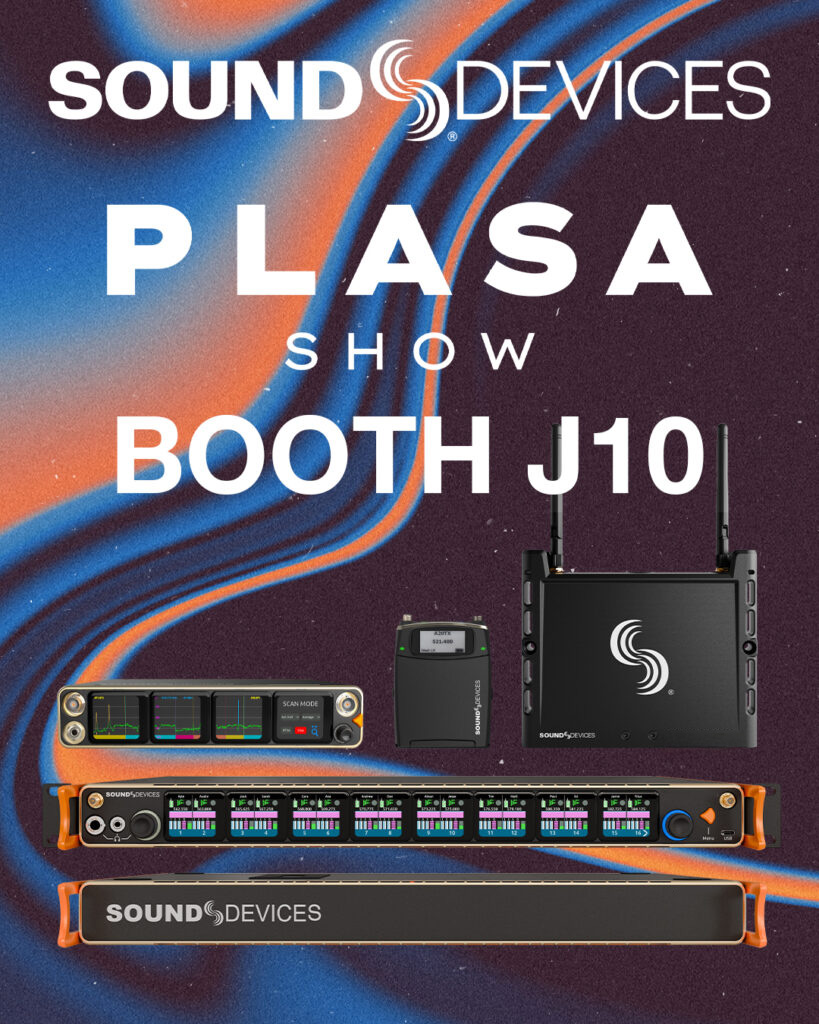
The Astral ARX32 receiver builds upon the industry-first features of the Sound ARX16 and Sound ARX8 receivers, by offering even more channels, flexibility, and versatility in a single wireless receiver than ever before. Ideal for large productions, live events, international tours, festivals, and beyond, it has unmatched channel density – a base 16 channels that are expandable up to 32 channels of clean, reliable RF in just a 1U 19” rack unit. The Sound ARX32 receiver is operable worldwide due to its unprecedented 169-1525 MHz global tuning range courtesy of Sound Devices’ category-defining SpectraBand Technology, and has built-in HexVersityⓇ (2-to-6-antenna diversity) for multiple antenna configurations. The Sound ARX32 receiver also includes the new RF Mirror Mode for full redundant operation.
In addition, Sound Devices will also be showcasing the new Astral Outpost NL that allows for remote-mounting NexLinkⓇ antennae via Ethernet, and the Astral Opto expansion box, which adds native Optocore audio I/O to the Sound ARX32 receiver for DiGiCo console interconnectivity. Sound Devices has started integration work with DiGiCo to put RF control directly into the workflow of audio engineers. With the addition of these products, the Astral series brings some of the most compact, full-featured wireless products to the market, for a wide range of live sound and touring applications.
“We’re incredibly pleased for the opportunity to showcase the Astral family to European professionals for our first ever appearance at the PLASA Show,” said Sound Devices Vice President of Sales Andy “Baggy” Robinson. “Astral represents years of innovation and development in wireless technology paired with decades of experience in developing compact, reliable sound equipment for the location sound market. Combined, we believe that makes Astral a compelling prospect for live sound professionals looking for features and functionality
that push beyond what is currently available and into the next generation of high-end wireless technology.”
The Astral system is nominated for a PLASA Innovation award and will be on display in the Innovation Gallery at the PLASA Show, as well as in Sound Devices’ booth, J10.
For more than 25 years, Sound Devices has created premier audio equipment that helps sound professionals capture superior audio. The company’s products have been used for an array of applications, from award-winning feature films and television shows, to live events, houses of worship, and educational applications. Sound Devices designs, assembles, and supports its products at their Reedsburg, Wisconsin, headquarters and their Madison, Wisconsin, and Rickmansworth, UK, offices.
Up until now, users wishing to measure the frequency and phase response of their loudspeaker systems have had to rely on either cumbersome hardwired microphones or utilize subpar wireless systems, with undesirable phase and frequency response. Now, with Astral ARX16/ ARX8 v1.63 and Astral Mini/Astral TX v7.64, users can utilize an Astral ARX16/ ARX8 receiver along with Astral TX or Astral Mini transmitters to very accurately measure the phase and frequency response of loudspeaker arrays, with near cable-like response.
Shown in the diagram below is the ruler-flat, measured phase and frequency response of the combined system using Smaart Suite software.
This response, combined with the following features of Astral TX transmitters and Astral ARX16/Astral ARX8 receivers make the Astral system ideal for demanding situations utilizing high-quality balanced measurement microphones:
New test and measurement mode streamlines production prep for large-scale touring
LOS ANGELES, CA, August 27, 2024 — In August of 2023, the Jonas Brothers launched an expansive world tour that has seen the popular performers playing hits from their entire discography in front of adoring fans at major venues across the globe. The FOH audio team of FOH Engineer Adam Robinson and Audio Systems Engineer Cameron Manes spearheads the crucial audio elements of the shows. Given that the tour would be visiting a very wide range of venues, Robinson and Manes were eager to develop an optimized methodology to getting the most consistent sonic performance in each venue. The pair adopted the Astral ARX16 receiver and its new Test and Measurement Mode to streamline this approach.
Expanding understanding with cutting-edge tech The basis of Robinson and Manes’ working partnership is a shared appreciation for the creative skillset required to deliver a life-changing front of house experience on shows of this scale. While there is an overwhelming influence of technology on the profession, neither have forgotten this critical perspective. “Front of house is inherently an artistic pursuit — how you can elevate the emotional experience of live music,” says Robinson. “Despite how nerdy we can get over technology, we never want to lose sight of how important that aspect is for both the performers and the audience.”
“That core idea has a major impact on how we work together on these shows because the people on the technical side are artists as well,” adds Manes. “Part of our artistry is to adopt technology that is accurate, reliable, and sets our minds at ease so that Adam can focus on creating art and not worry about whether the systems are working properly.”
“It’s something that has really led us to push the boundaries as a team of what can be achieved and how we can utilize the tech to streamline important processes in the sound production of shows of this scale.
Although the test and measurement process — a careful check that ensures all audio systems are responding predictably in each venue — is an important part of any large audio production, its purpose is frequently misunderstood even by professionals in the field. Ensuring consistent performance from speaker systems can be the difference between a successful performance or a disastrous one. “The key word in all of this is consistency,” explains Manes. “What many people don’t understand is that it takes a trained ear to recognize if the system is reacting differently in different parts of the room. It may ‘sound good’ somewhere, but if the entire system isn’t providing a similar sounding experience to every seat of the house, then the show can be a failure.”
Adding to the potential pressure on large productions is that oftentimes test and measurement can be a rushed affair given how long it can take to set up the proper equipment. For Manes, this is something that drove him and Robinson to think differently about how to streamline the process for this tour. “We really only have about thirty minutes to conduct this process in each venue,” Manes says. “Finding ways of doing it more efficiently and getting better results was something we were always in search of as it’s very important for the final product.”
“When Sound Devices added T&M mode to the Astral ARX16, we immediately signed up to be beta testers because we saw the opportunity to completely overhaul the process for the better.”
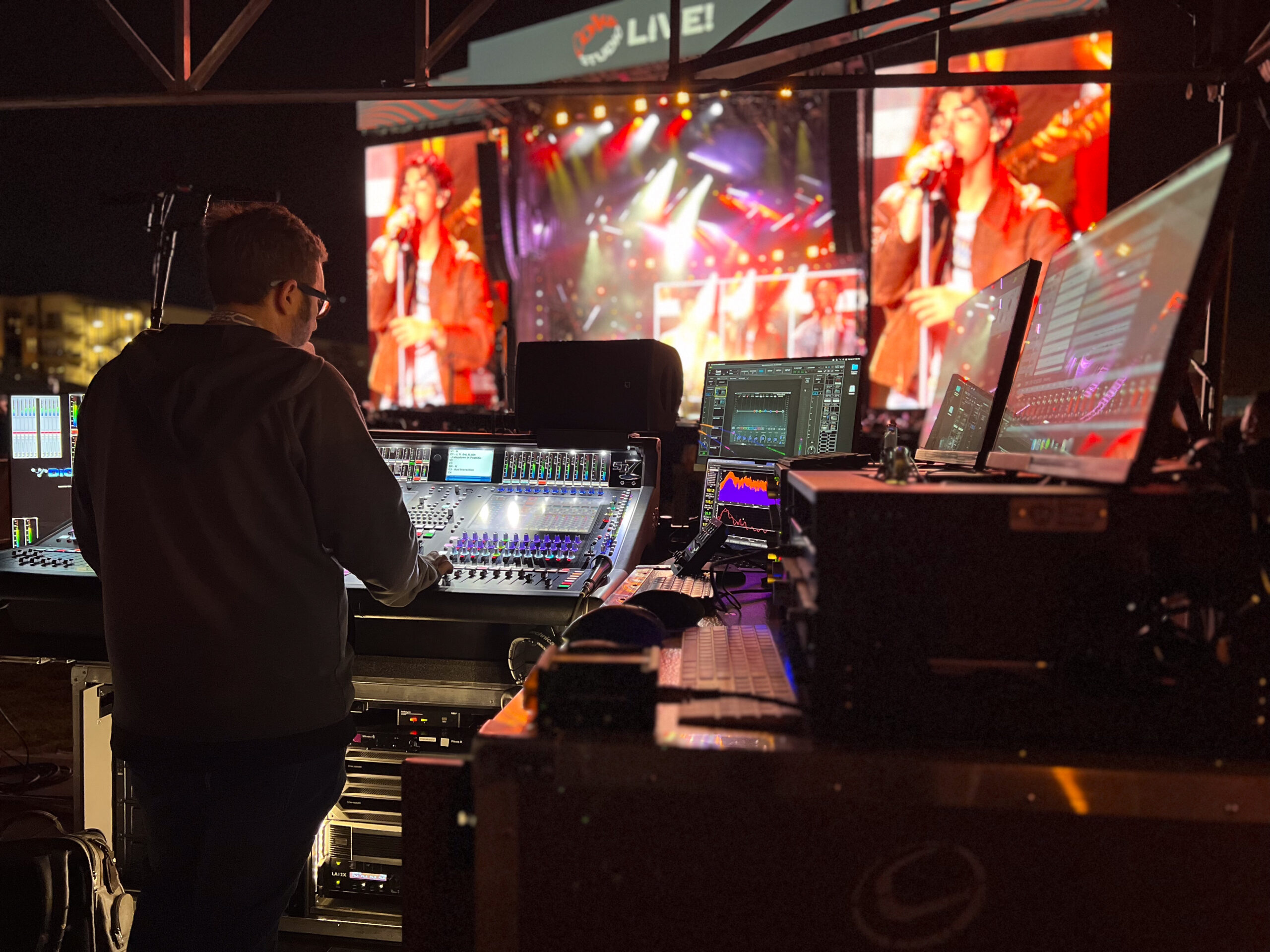
Manes operating T&M mode in the field
Efficient systems for superior sound The basis of Robinson’s FOH rig for the tour is the DiGiCo Quantum 7 console and d&b KSL line arrays supplied by longtime partner Clair Global. The measurement system that he and Manes devised utilized four Sound Devices Astral TX wireless transmitters paired with Isemcon EMX-7150 microphones and an Astral ARX16 receiver that ties in via Dante to a DirectOut Prodigy.MP system controller, providing system management and output routing as well as feeding the test signals to Rational Acoustics Smaart measurement software. The ability to work wirelessly proved to be a game changer. “Most wireless measurement systems up until this point simply didn’t give accurate enough results as they would impart something incorrect on the measurements in terms of frequency and phase shift,” says Robinson. “With the Sound Devices T+M Modulation Algorithm, there is no frequency or phase shift, so we were getting the exact same measurements we’d get from a wired microphone but with much more flexibility in terms of speed and placement.”
“That’s utterly groundbreaking and has a huge impact on how quickly we can conduct this process.”
“It immediately made our T+M process that much more efficient,” agrees Manes. “We were able to measure so many places at once and see the difference between the locations instantaneously. We’re doing a lot less double-checking now since we know we can trust the measurements that we get.”
Implementing the new test system within their existing FOH setup proved to be relatively straightforward. Robinson and Manes were able to quickly dive in and make the Astral ARX16 receiver work without too many headaches. “Sound Devices is known for making robust hardware and they really take that extra step to understand how professionals will use it and put thought into every detail,” says Manes. “The UI is incredibly intuitive, and it was very easy to get everything set up.”
“It’s beautiful gear that we’ve come to trust for what we need to accomplish. Everything worked exactly as it needed to — even as a beta! — and there was very little to have problems with.”
With an efficient test and measurement system in place, the main focus of the partners has returned to the creative outcomes inherent in delivering heightened emotional experiences around the musical performances of the tour. Consistency having been achieved, this core goal is being enjoyed more than ever before. “At some point, we always have to push the technology aside and focus on the creative and artistic space around these massive productions,” says Robinson. “Being able to rely on that consistent response has made it so much easier to do that and has had such a positive impact on the sound of these shows.”
“We have a habit of bringing new electronic toys on each tour that we do together,” adds Manes. “The Astral ARX16 was one of them — but it totally changed how we work, and our hats are off to Sound Devices for creating something that’s become so essential to us so quickly.”
About Sound Devices: For more than 25 years, Sound Devices has created premier audio equipment that helps sound professionals capture superior audio. The company’s products have been used for an array of applications, from award-winning feature films and television shows, to live events, houses of worship, and educational applications. Sound Devices designs, assembles, and supports its products at their Reedsburg, Wisconsin, headquarters and their Madison, Wisconsin, and Rickmansworth, UK, offices.
Reader-driven industry award recognizes excellence in Service and Support teams
Sound Devices announces that its Service and Support Teams have been honored with a Gold Award for Best Tech Support from Systems Contractor News as part of the publication’s 2024 Stellar Service Awards. The Stellar Service Awards recognize standout service providers amongst manufacturers, distributors, and integrators in the industry and are voted upon by the readership of Systems Contractor News annually.https://www.avnetwork.com/systems-contractor-news
“We’re incredibly proud to see our service and support departments honored with this award,” said Sound Devices CEO Matt Anderson. “This is a testament to the rock-solid work that they’ve done for over two decades and the trusting relationships they’ve formed with our long-time Sound Devices users.”
Behind the scenes with an award-winning team
Sound Devices service and support departments are unique in the industry in that they still actively service products from the entire lifetime of the company, going back to its founding in 1998. This type of long-term support requires highly skilled technicians with a knowledge of hardware and software technology dating back several generations in terms of audio and computer technology. “Sound Devices legacy products that were introduced to the market over 25 years ago are still relevant today and used in a variety of applications by amateurs and professionals around the world,” explains Sound Devices Director of Technical Services Randy Woodworth. “This means that our Technical Support Reps and Service Technicians must remain fluent with the older equipment while adapting to new technology. It also presents us with the challenge of maintaining an extensive inventory of parts that allows us to service every product that we’ve sold.”
“Our customers love Sound Devices products and know that they can depend on us to support, maintain, and preserve their investments.”
The team of service and support technicians operate in a highly collaborative fashion across department lines to ensure that each customer ticket receives individualized attention. Doing so ensures the full breadth of company experience can be utilized to problem-solve. “We’re very hands-on with each unit and there is a lot of collaboration that occurs behind the scenes,” says Sound Devices Support Team Manager Danny Greenwald. “We’re all interested in each other’s repairs and can work faster because we’re a tight team together.”
“There’s an immediate relationship between the service and support sides and that ultimately benefits our customers because it means they’re able to rely on that combined experience to service these products.”
Personalized service, industry-leading warranty support
The collaboration also extends between offices, as the team in Reedsburg, WI communicates and collaborates regularly with their colleagues in Watford, UK. For UK customers, this has organically resulted in in-person sessions with Watford’s experienced techs who can also be informed by the engineers in the United States. “Due to our proximity to London, it’s become a handy way for us to add another layer of service to our customers,” says Sound Devices Technical Support Representative Harri Kimonos. “Even still, we benefit from the hive mind and can easily call on our experts like Gary Trenda, Paul Isaacs, Kish Patel, and our entire QA team to solve any problem our customers run into.”
“Ultimately we want them to leave their experience with us knowing that they can rely on us just like they can rely on our products.”
A major factor in the long-term reliability of Sound Devices products is how the company provides warranty support. Sound Devices offers a two-year factory warranty on all registered products. If a unit is brought in for repairs, Sound Devices’ technicians conduct rigorous testing and return it to factory specs once the unit has been fixed to ensure its longevity. The product is then returned to the customer with an additional one-year Service Warranty as an added layer of protection. “We all have experience in the industry, and we know how attached people get to their workflows with technology,” says Greenwald. “Given that, it’s incredibly important that these units work when they are supposed to and continue to work for the long haul on these high-pressure jobs.”
“That’s why we offer these Service Warranties. We want our customers to know that we understand their needs and are just as invested as they are in keeping this gear in the field.”
“It’s really heartening as a team to see our customers take the time to recognize us with an award like this,” concludes Woodworth. “We love that we’re able to help them problem-solve every day and we’re happy to stay in the trenches with them as long as it takes to get their gear working and back out in the field.”
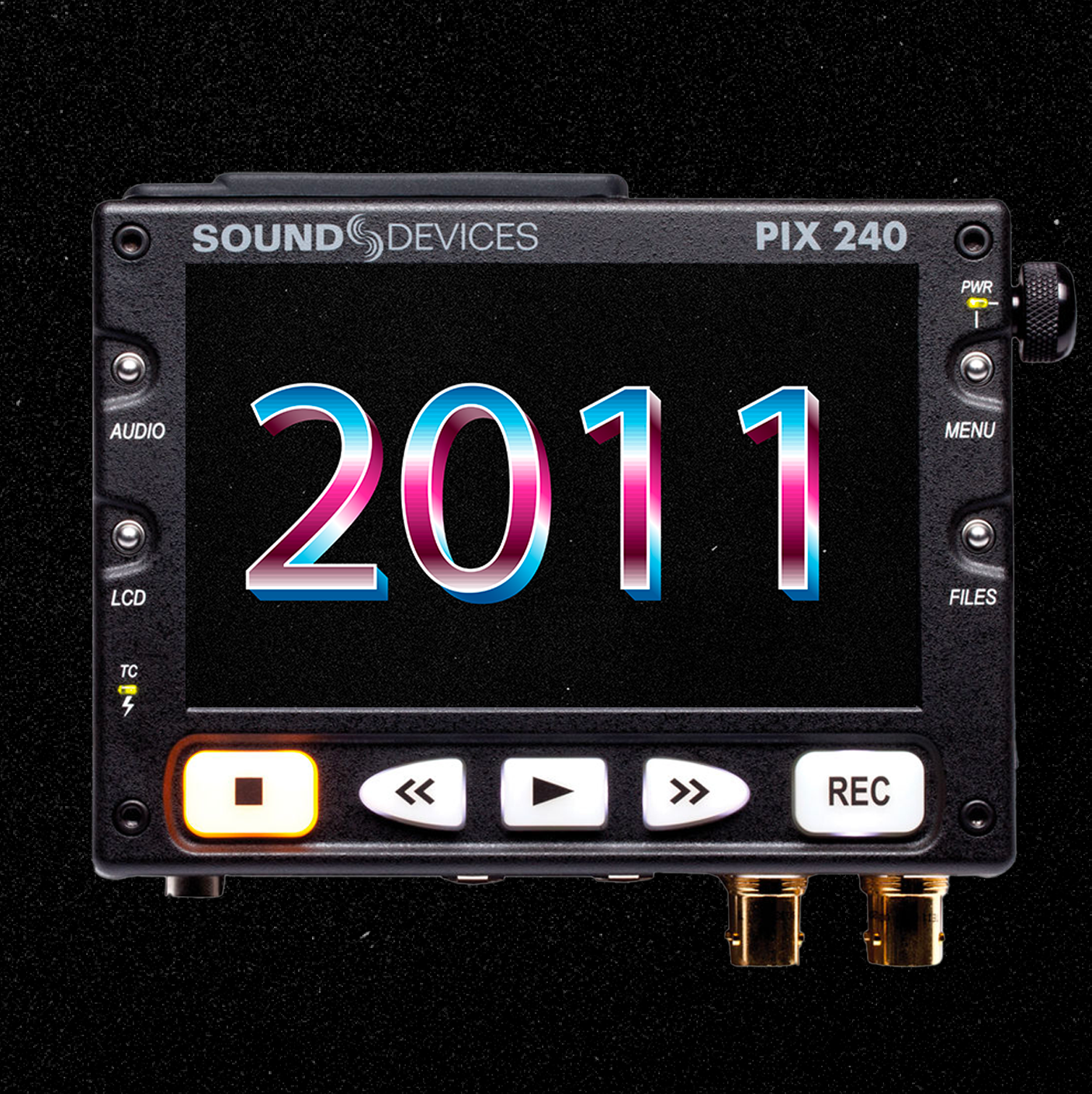
“The PIX240i came out a year after the original PIX240. The only real difference between the two was a much better looking IPS display. The original PIX240’s display exhibited jello-like wobble when a camera panned and was displaying it on the screen. It was a rolling-shutter-like artifact, but on the screen instead of a camera sensor. This seems like a somewhat insignificant change, but like many changes that look simple to the outside world, it was far more difficult on the engineering side. It’s rare that you can buy a part – like a screen – from one vendor and it simply drops into the product with no changes. If memory serves, we had to change our injection molds to accommodate the new screen as well as the driver circuitry, both of which are pretty huge changes that took many months to do. The new IPS screen from Mitsubishi was brighter, had better scan time, and didn’t exhibit any of the jello effect. We went on to make the PIX240i for several more years, and this improved screen was a big part of its popularity. The PIX220i was simply a lower-priced version of the PIX240i in which we omitted the SDI in/out. As the parts needed to implement SDI in and out are very expensive, this did allow us to sell the HDMI-only version PIX220i at a lower price, but it was never as popular as the PIX240i.”
“The PIX 240 was our first video product. We (perhaps naively) thought we could parlay our digital recording and timecode expertise into a new market: video. We fielded calls almost daily about timecode and how to sync up sound with video. We figured – why not record both on one device? I could never convince camera manufacturers to integrate decent audio inputs. We decided to sort of be the camera ourselves and record our own high-quality video along with our very high-quality audio, eliminating the need for timecode. There were tons of nice cameras with great sensors spitting out uncompressed video via SDI, but the internal (tape or card) recording on the cameras was terrible. I knew that we could record the rates we needed to 2.5” drives reliably, but just needed to get a license from Apple to implement ProRes on an FPGA. I approached them several times but was told that Aja had an exclusive. I hired the engineering firm Atterotech (Fort Wayne, TX), whose engineers knew both audio and video. They found a company who manufactured an odd 360 core processor which somehow had an Apple license, so we went that route. Atterotech and I designed the hardware together – I drafted behind these very talented engineers until I learned all the ins and outs of designing video. Mike Lawson (Mechanical Engineering) designed the chassis and the docking 2.5” HDD caddy. He and I spent some time working on the cooling of this product and utilized a large-diameter, slow spinning fan on the back. It was utterly silent and cooled the massive multi-core processor well. The video topped out at 1080p30 and we recorded in either ProRes or DNxHD. We introduced the product thinking we had a hit on our hands, and we did. People still tell us they think the PIX 240 was one of the best products we ever produced.”